

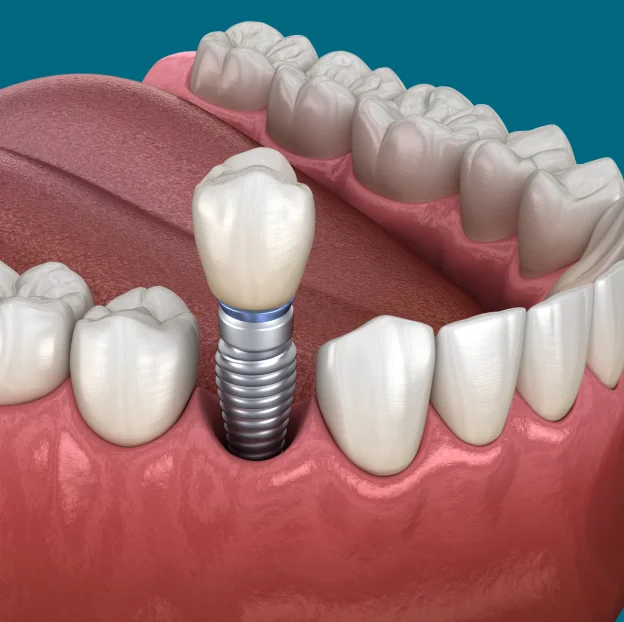
Why Patients Choose Dental Implants
Dental implants offer a combination of durability, function, and natural appearance that makes them a reliable long-term tooth replacement option. The implant fuses with the jawbone to provide a stable foundation while helping preserve bone density that may decline after tooth loss.
Unlike some restorations, implants do not rely on surrounding teeth for support and can function much like natural teeth when eating and speaking. With proper care, they can last for decades while blending naturally with the surrounding smile, helping restore both confidence and everyday oral function.
Dental Implants for Different Tooth Replacement Needs
Implant treatment can be planned in several ways depending on how many teeth are missing and where the gaps are located. The restorative approach is selected after evaluating the individual condition of the mouth.
- Single missing tooth: One implant can support a dental crown to replace an individual missing tooth.
- Several adjacent missing teeth: Implants may support a bridge designed to replace multiple missing teeth.
- Multiple missing teeth: Implant-supported denture options may provide additional support for certain tooth-replacement plans.
- Complex restorative needs: Implant treatment may be coordinated with crowns, bridges, or other restorative services when appropriate.
Your Path from Tooth Loss to Restoration
Dental implant treatment can involve several stages, and the exact sequence varies according to the number of missing teeth, oral health, and restoration being planned. The team will explain the recommended steps before treatment begins.
Evaluate Your Oral Health
The team reviews your dental history and examines the missing-tooth area, surrounding teeth, gums, and supporting structures to assess whether implant treatment may be appropriate.
Plan the Restoration
The recommended implant approach is discussed based on the location and number of missing teeth, the condition of the supporting structures, and the type of restoration needed.
Place the Implant
When treatment proceeds, the dental implant is placed in the planned location within the jaw. Appropriate healing time follows placement so the implant can integrate with the surrounding bone.
Monitor Healing
Follow-up visits allow the team to monitor healing and determine when the implant is ready to support the next stage of restorative treatment.
Complete the Restoration
Once healing is appropriate, the planned crown, bridge, or denture restoration is connected to the implant or implants, completing the tooth-replacement treatment.
Who Is a Good Candidate for Dental Implants?
Dental implants are generally well suited for patients missing one or more teeth who have adequate jawbone density and generally healthy gums to support the implant. Non-smokers and patients without uncontrolled underlying health conditions that affect healing tend to be strong candidates.
Patients with insufficient bone structure may still be candidates after a bone grafting procedure. A thorough evaluation, including imaging of the jaw, helps our team determine whether implants are the right fit for your specific needs.
Tailored Support to Replace Missing Teeth
Terrell Family Dentistree, located in Terrell, TX, is committed to helping patients restore missing teeth with lasting, natural-looking results. Whether you are exploring implants for the first time or ready to move forward with treatment, our compassionate team is here to guide you through every step. Call us at (972) 210-7254 to schedule a consultation and learn more about your options.
Schedule Your Dental Implant ConsultationFrequently Asked Questions About Dental Implants
With proper care, dental implants can last several decades, and many patients keep their implants for life. The crown portion may eventually need replacement due to normal wear.
The implant placement procedure is performed under anesthesia, so patients typically feel little discomfort during surgery. Mild soreness during healing is common and manageable with standard care.
The full process often takes several months from placement to final crown attachment, allowing adequate time for the implant to properly integrate with the jawbone.
Patients with insufficient bone density may still qualify for implants after a bone grafting procedure, which helps build up the jaw to support the implant.
No, the custom crown attached to the implant is designed to closely match the size, shape, and color of surrounding teeth for a natural appearance.
Yes, multiple implants can support a bridge or full denture, offering a stable solution for patients missing several teeth or an entire arch of teeth.
Dental implants should be brushed, flossed, and cared for like natural teeth, along with regular dental visits to monitor the health of the implant and surrounding gums.
Age alone does not disqualify a patient from getting an implant. Overall health, bone density, and gum condition are more important factors in determining candidacy.